
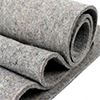
What is Strip Cutting?

Strip cutting, also known as slitting, is a manufacturing process that involves cutting a wide roll or sheet of material longitudinally into multiple narrower rolls or strips. For materials like felt and rubber, this is typically achieved using rotary blades or guillotine cutters with exceptional precision.

Key Benefits of Strip Cutting

  • Precision and Consistency: Achieving extremely tight tolerances, which is crucial for applications requiring exact dimensions.
  • Minimal Waste: Optimised cutting patterns maximise material yield from the original sheet or roll.
  • High Volume Production: Efficiently processes large quantities of material quickly and cost-effectively.
  • Versatility: Adaptable to various material thicknesses, densities, and durometers (hardness) of felt and rubber.
British Felt - Strip Cutting

Strip Cutting Rubber

Rubber, valued for its elasticity, durability, and resistance to abrasion, chemicals, and temperature, is strip cut for countless sealing, mounting, and isolation applications.

Common Rubber Applications for Strip Cutting

Application

Description

Rubber Spacers

Uniform strips are used to create separation or provide support between components.

Sealing Strips

EPDM, Neoprene, or Silicone strips for environmental and fluid sealing.

Mounting Tapes

Strips of rubber (often with adhesive backing) for secure and anti-vibration mounting.

Custom Profiles

Starting material for further fabrication into specialised rubber parts.

The Process: Rubber’s elasticity and varying durometers demand specialised machinery. The cutting process must prevent “drag” or deformation of the material to ensure straight edges and accurate widths, often utilising high-pressure or computerised rotary cutting systems.

Strip Cutting Felt

Felt, a textile known for its sound-dampening, cushioning, and filtering properties, requires careful cutting to maintain its structural integrity and dimensional stability.

Common Felt Applications for Strip Cutting

Application

Description

Gaskets & Seals

Thin, precise strips for preventing leaks and vibration in machinery.

Wicking Strips

Narrow strips used to transfer or absorb fluids (e.g., in lubrication systems).

Weatherstripping

Uniform strips for sealing doors and windows against drafts and moisture.

Cushioning Pads

Small, high-density strips for protective packaging or vibration isolation.

Specifications for Strip Cutting

We work with a comprehensive range of material types and can meet exacting specifications:

  • Materials Handled: Natural Felt (Wool, Synthetic Felt (Polyester, Acrylic)), Neoprene, Silicone, EPDM, SBR, Natural Rubber.
  • Strip Widths: From 3mm up to the full width of the material roll.
  • Tolerances: Down to 0.25mm depending on the material’s thickness and type.
  • Thickness: Capable of cutting materials from thin films up to 25mm (1”) thick.